
Space Weather
Sun Goes Spotless for First Time in Three Years
The Sun Just Hit Pause For the first time since June 2022, the sun's surface went completely blank on February 22, 2026. No sunspots. No magnetic turbulence. No dark, cooler patches that typically herald incoming solar storms. The observation marks a rare moment of calm on our star's perpetually res...

NASA's Twin Spacecraft Will Map Mars' Atmospheric Death
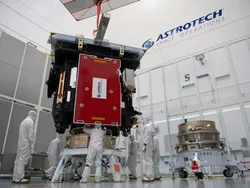
NASA's Twin Spacecraft Will Map Mars' Atmospheric Death NASA's ESCAPADE mission has switched on its science instruments, marking the first operational phase of an unprecedented dual-spacecraft venture to understand how the Sun systematically stripped Mars of its once-habitable atmosphere. Launched N...

Webb Telescope Reveals Uranus's Hidden 3D Aurora Dance
Webb's First 3D Aurora Map Reshapes Understanding of Uranus For the first time, the James Webb Space Telescope has captured Uranus's auroras in full three dimensions, revealing how energy cascades through the ice giant's lopsided magnetic field in ways never before observable. The discovery, publish...

ESA captures 'ring of fire' eclipse from space in ultraviolet light
ESA's Proba-2 Captures Rare Annular Eclipse From Above Atmosphere On February 17, 2026, the European Space Agency's Proba-2 satellite achieved what ground-based observatories cannot: a crisp, unobstructed view of an annular solar eclipse from space. The spacecraft captured the event in extreme ultra...
China's Storm Alert System Just Prevented a Blackout Nightmare
A Superstorm Hits, and China's New Monitoring Network Proves Its Worth In May 2024, a geomagnetic superstorm slammed Earth's magnetosphere with the force of a space-based haymaker. Thanks to China's newly operational Chinese Meridian Project (CMP)—a ground-based monitoring network that tracks magnet...

New Zealand detects largest magnetic storm in 30 years
Aurora Alert: New Zealand's Magnetometer Network Catches Biggest Storm Since 1994 New Zealand has caught its most violent geomagnetic storm in three decades, thanks to a freshly completed network of magnetic field sensors that went live just in time to witness solar chaos. The MANA (Magnetometer Arr...
Eclipse chasers reveal the Sun's hidden turbulence—and why it matters
The Discovery Astronomers have finally caught the Sun in the act of creating its own weather. Using data from total solar eclipses spanning nearly 12 years, researchers at the University of Hawaiʻi's Institute for Astronomy have identified and tracked turbulent structures in the Sun's corona—the sup...
AI Predicts Solar Storms Weeks Ahead, Protecting Earth's Power Grid
Scientists Deploy AI to Forecast Solar Storms Weeks in Advance Researchers at Southwest Research Institute and NSF-NCAR have developed PINNBARDS, a physics-informed neural network that predicts dangerous solar eruptions up to three weeks before they strike—a dramatic leap beyond the hours-long warni...
Saturn's Tiny Moon Broadcasts Electromagnetic Power Across 500,000 Kilometers
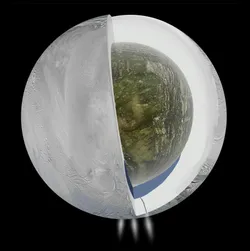
A Pocket-Sized Moon with Outsized Cosmic Reach Enceladus, one of Saturn's smallest moons at just 500 kilometers in diameter, has been caught doing something remarkable: broadcasting an electromagnetic web across half a million kilometers of space. New analysis of data from NASA's Cassini spacecraft ...
Stellar Tantrum 10,000x Worse Than Earth's Worst Solar Storm
A Star's Rage Threatens Worlds Astronomers have detected one of the most violent stellar explosions ever recorded—a flare from a distant M dwarf star that dwarfs even the most catastrophic space weather Earth has ever endured. The discovery, made by the Next-Generation Transit Survey (NGTS) and publ...

NASA Wants You to Hunt Solar Storms from Your Couch
Citizen Scientists Get Frontrow Seat to Earth's Magnetic Drama NASA is opening its doors to amateur researchers, inviting the public to help decode one of space's most violent—and beautiful—phenomena: the collision between Earth's magnetic shield and the Sun's relentless particle stream. The Space U...

NASA's twin rockets decode the sky's strangest light show
NASA just launched two rockets from Alaska to solve a cosmic mystery: black auroras, where electrons do the opposite of what they're supposed to do. Instead of flowing toward Earth like normal auroras (those pretty green curtains), these electrons rocket away into space. Scientists still don't know ...
