A Pocket-Sized Moon with Outsized Cosmic Reach
Enceladus, one of Saturn's smallest moons at just 500 kilometers in diameter, has been caught doing something remarkable: broadcasting an electromagnetic web across half a million kilometers of space. New analysis of data from NASA's Cassini spacecraft reveals that this icy world generates Alfvén waves—rippling disturbances in magnetic field lines—that propagate far beyond what planetary scientists expected, fundamentally reshaping how we understand moon-planet interactions in our solar system and beyond.
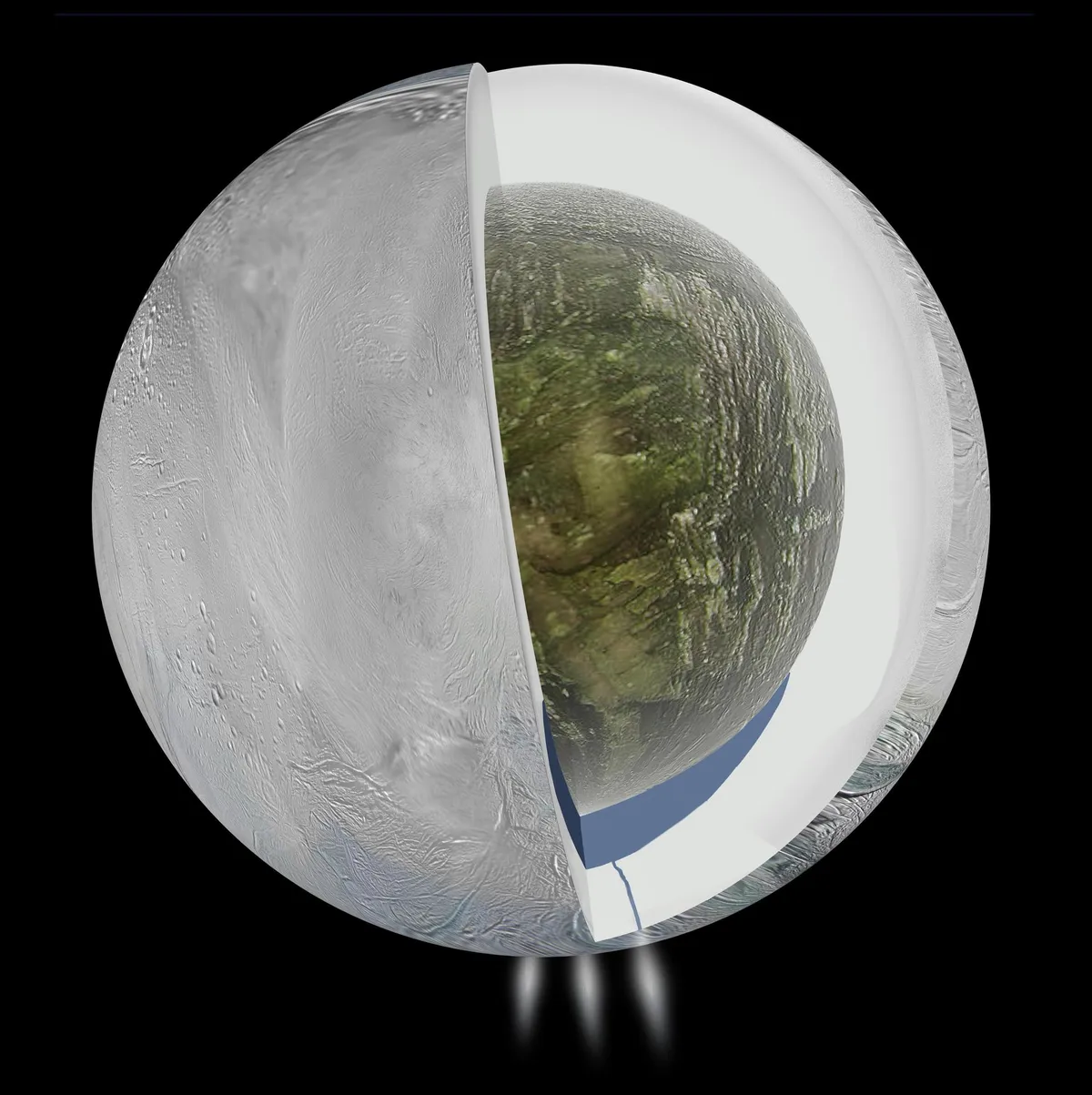
The discovery, published in the Journal of Geophysical Research: Space Physics, reveals that Enceladus doesn't just have local influence. Its water geysers, which erupt from a subsurface ocean, inject charged particles into Saturn's magnetosphere. These particles interact with the planet's magnetic field to create waves that reflect repeatedly through space rather than dissipating, forming what researchers describe as a "planetary-scale Alfvén wave generator."
How a Geysering Moon Becomes a Radio Broadcaster
The mechanism is elegant and unexpected. When Enceladus' cryovolcanic geysers erupt, they release water vapor and organic compounds into the thin local environment. These neutral molecules become ionized through interaction with Saturn's intense radiation field, creating a plasma. This plasma couples with Saturn's magnetic field lines, generating Alfvén waves—essentially magnetic vibrations that travel along the field like ripples on a cosmic string.
Where previous observations expected these waves to fade after a single reflection, Cassini's magnetometer data shows something different: the waves bounce between Saturn's ionosphere and plasma torus (a doughnut-shaped cloud of charged particles ringing Saturn), creating a persistent electromagnetic lattice. Thomas Chust of the Laboratoire de Physique de Plasmas noted: "This is the first time such an extensive electromagnetic reach by Enceladus has been observed. The findings demonstrate that this small moon functions as a giant planetary-scale Alfvén wave generator, circulating energy and momentum throughout Saturn's space environment."
Researchers identified Alfvénic perturbations in Cassini's non-flyby data from multiple passes, mapping a complex spatial distribution that stretched across Saturn's magnetosphere. The waves maintain coherence over distances that dwarf the moon itself—comparable to the Earth-Moon distance, repeated multiple times over.
Why This Matters Beyond Saturn
The implications ripple outward through planetary science. Jupiter's large moons—Europa, Ganymede, and Callisto—almost certainly generate similar electromagnetic structures, though they haven't been systematically studied in the same way. Understanding Enceladus' mechanism provides a template for recognizing and interpreting these interactions elsewhere.
More speculatively, exoplanetary systems with moon-planet pairs may exhibit identical physics. As space agencies plan missions to ocean worlds and systems with complex magnetospheres, this research clarifies what signatures to look for and what scales to expect. Additionally, Enceladus' electromagnetic activity directly drives aurora production on Saturn—visible proof that energy from the moon is actively shaping the planet's upper atmosphere.
The work also demonstrates how remote, robotic observations can yield unexpected complexity from old data. Cassini's mission ended in 2017, yet its instruments continue yielding discoveries about the Saturn system's electrodynamics.
Next Steps in the Exploration
Future missions to Saturn—including potential orbiter concepts under study by NASA and ESA—will carry upgraded magnetometry and plasma instruments designed partly in response to findings like these. Understanding Alfvén wave generation could prove critical for designing spacecraft trajectories near geologically active moons and predicting radiation hazards. For now, Enceladus remains one of the solar system's most intriguing laboratories for studying how small bodies shape planetary environments on continental scales.