
The Hunt for Worlds Beyond Planets
For decades, astronomers have been finding exoplanets by the thousands. Yet despite discovering over 5,000 worlds orbiting distant stars, they've confirmed zero exomoons and zero exorings. That dry spell may be ending. Recent advances in detection technology and new observational techniques are bringing the first confirmed exomoon within reach—a milestone that could reshape our understanding of planetary system architecture across the galaxy.
The challenge is fundamental: exomoons orbit planets that orbit stars light-years away. They're too faint and too close to their host planets to image directly with current telescopes. But astronomers have developed clever indirect methods to hunt for them, and the results are tantalizing.
Following the Shadows
The most established technique exploits the transit method—the same approach that identified most known exoplanets. When a planet passes in front of its star from our vantage point, the star dims slightly. An orbiting moon should create subtle asymmetries in this brightness dip, distorting the expected U- or V-shaped curve that astronomers plot over time.
Kepler-1625b offers a prime example. Discovered in 2016, this super-Jupiter (a world with the mass of roughly a dozen Jupiters) showed odd bumps in its light curve that astronomers attributed to a massive exomoon—one roughly Neptune-sized, orbiting its host planet. Since then, the evidence has proven controversial, with competing papers arguing for and against its existence. It remains a candidate, not yet confirmed.
Other detection methods are gaining traction. Transit timing variations measure subtle shifts in when and how long planetary transits occur, caused by the gravitational tug of orbiting moons. Astrometry—measuring the precise position and wobble of planets across the sky—offers another avenue. The GRAVITY instrument on the Very Large Telescope in Chile recently detected borderline evidence for a massive companion around HD 206893 B, a brown dwarf about 20 times Jupiter's mass. If real, this "moon" would orbit every nine months and carry roughly half Jupiter's mass.
A Hot New Method: Following the Volcanoes
Perhaps most intriguingly, astronomers are now hunting exomoons through volcanic activity—inspired by Jupiter's Io, which erupts constantly as the giant planet's gravity heats its interior. Using the James Webb Space Telescope and other observatories, researchers detected fluctuating sulfur dioxide clouds around the exoplanet WASP-39b and near WASP-49Ab, suggesting potential eruptions from tidally heated exomoons that might rival Io in ferocity.
These detections aren't conclusive, but they signal a new pathway opening up. Unlike direct imaging, which remains impractical, these methods exploit the physical consequences of exomoon existence—transits, gravitational wobbles, thermal signatures—making detection feasible with instruments already in the sky.
What About Rings?
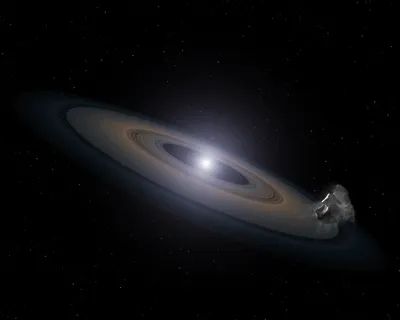
Exorings, while seemingly simpler to detect given their large area and brightness, present unexpected challenges. They can fade or align edge-on relative to our vantage point, making them temporarily invisible even if present around many exoplanets.
What's Next
The next critical milestone arrives with GRAVITY+, a sharper-eyed upgrade currently in testing. This enhanced instrument should definitively confirm or rule out the HD 206893 B companion within the next few years. Meanwhile, continued JWST observations and transit data from missions like TESS will accumulate evidence for other candidates. Within five years, astronomers expect to confirm the first exomoon—a watershed moment that will prove moons and rings are as common around distant planets as they are in our own solar system.