
Latest by Segment
Pentagon Threatens Defense Contractor Over AI Safety Rules
AI Ethics Clash Threatens Pentagon-Anthropic Partnership In a rare showdown between a major defense contractor and an AI company over ethical guardrails, Anthropic CEO Dario Amodei has publicly refused Pentagon demands to remove safety restrictions on how its Claude AI model can be deployed in military operations. The Department of Defense has given the company until 5:01 PM ET Friday to capitulate or face designation as a "supply chain risk"—a label previously reserved for adversarial nations—and potential invocation of the Defense Production Act to forcibly remove the safeguards. At the center of the dispute: Anthropic's refusal to loosen policies that prevent its AI from being used in lethal autonomous weapons and mass domestic surveillance operations. While Pentagon officials claim they have "no interest" in either application, they argue that no private company should be allowed to impose restrictions on how the U.S. military uses its own tools—a governance question with implications far beyond this single contract. The Escalation The conflict erupted after the Department of Defense's Chief Digital & AI Office awarded Anthropic (along with Google, xAI, and OpenAI) contracts worth up to $200 million each in summer 2025 to customize generative AI systems for military applications. Since then, classified versions of Claude have been made available to Defense Department personnel through Amazon and Palantir infrastructure. Amodei reportedly met with Secretary of Defense Pete Hegseth this week in a direct attempt to resolve the dispute, but negotiations failed. DoD Undersecretary for Research and Engineering Emil Michael accused Amodei of harboring a "God-complex" and attempting to "personally control the US Military," framing Anthropic's position as a threat to national security. Pentagon spokesperson Sean Parnell characterized the request as "simple, common-sense"—allowing military use for "all lawful purposes"—and warned that refusal could "jeopardize critical military operations and potentially put our warfighters at risk." Amodei countered that the Pentagon's threats are "inherently contradictory": simultaneously labeling Anthropic a security risk while declaring Claude essential to national security. He emphasized the company's willingness to support U.S. defense and democratic interests, citing previous decisions to cut off funding to China and existing Pentagon partnerships. However, he drew a clear line on two areas where "AI can undermine, rather than defend, democratic values." The Deeper Governance Question This dispute reflects a fundamental tension in defense procurement: the extent to which private technology companies should retain control over their own products' applications. Michael argued it would be "not democratic" to "let any one company dictate a new set of policies above and beyond what Congress has passed," while Amodei framed the safeguards as necessary guardrails on powerful dual-use technology. Anthropically's position echoes broader industry concerns about AI autonomy and accountability that have emerged across defense and civilian sectors. The company has previously published detailed policies on acceptable AI use, drawing both praise from safety advocates and criticism from military and intelligence officials who view such restrictions as impediments to operational effectiveness. What Happens Next With a Friday deadline now public, the coming 48 hours will determine whether Anthropic capitulates, maintains its stance and accepts supply-chain-risk designation, or negotiates a middle ground with Pentagon leadership. Any resolution will likely establish precedent for how other AI companies—and broader tech contractors—negotiate ethical and operational constraints with the Defense Department. The outcome also carries implications for international security partnerships, as NATO allies and democratic nations watch how the U.S. reconciles technological capability with governance principles.
Europe's Ramses Mission Will Chase Apophis Through Earth's Cosmic Backyard
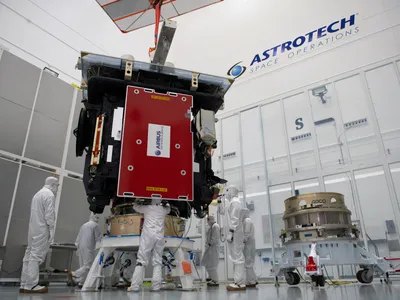
Europe's Ramses Mission Will Chase Apophis Through Earth's Cosmic Backyard On February 10, 2026, the European Space Agency awarded OHB Italia a contract to build the Rapid Apophis Mission for Space Safety (Ramses)—a spacecraft designed to intercept and study the near-Earth asteroid 99942 Apophis as it makes one of the closest approaches to our planet in recorded history. Scheduled for launch in 2028, Ramses will arrive at Apophis in time to collect detailed scientific data during the asteroid's April 2029 flyby, when it will pass within 32,000 kilometers of Earth—closer than geostationary satellites and well inside the Moon's orbital distance. This is not a speculative mission. Apophis is a real asteroid, roughly 370 meters across, whose orbital mechanics and Earth-intersection have been precisely calculated. What makes Ramses historically significant is the opportunity it represents: a well-funded, internationally coordinated spacecraft will be present as a potentially hazardous object swings through our cosmic neighborhood. The data collected will fundamentally advance planetary defense science and asteroid characterization—knowledge that will be essential if humanity ever faces a genuine impact threat. Why Now, Why Apophis? Near-Earth objects like Apophis have been part of the astronomical landscape for billions of years, but only in the past two decades have space agencies begun treating close approaches as legitimate scientific opportunities rather than purely defensive scenarios. The 2029 Apophis flyby represents a rare convergence: an object large enough to study meaningfully, approaching close enough for detailed observation, with sufficient warning time to mount a proper mission. ESA's decision reflects a broader shift in planetary defense strategy. Rather than waiting for a crisis, space agencies are building the observational and technological capability to understand potentially hazardous asteroids in detail. Missions like Ramses generate data that informs impact probability calculations, material composition models, and theoretical deflection strategies. Japan's Hayabusa2 and NASA's OSIRIS-REx demonstrated the scientific payoff from close-range asteroid study; Ramses will extend that model to a dynamically significant object with a non-zero historical impact probability. Mission Design: Small Satellites, Big Science Ramses will deploy multiple CubeSats during the encounter, including one named "Farinella" in honor of the late Italian planetary scientist Paolo Farinella. These small satellites—some weighing as little as a few kilograms—will gather data from multiple vantage points, allowing scientists to construct a comprehensive picture of Apophis's physical properties: surface composition, internal structure, rotation dynamics, and gravitational field. JAXA's contributions include solar arrays and a thermal infrared imager, underscoring the mission's international scaffold. OHB Italia, with decades of heritage in complex space systems, leads the primary spacecraft development. This collaboration model—European prime contractor, Japanese subsystems, Italian CubeSat manufacturer—has become standard in planetary science and reflects both the distributed expertise across space-faring nations and the economic reality of cost-sharing for ambitious projects. What's at Stake Ramses launches in approximately two years. Success means a high-fidelity dataset on a near-Earth asteroid at closest approach—the kind of information that accelerates impact-risk modeling and validates deflection-strategy simulations. Failure means a missed window that won't recur for centuries. For the planetary defense community, the stakes are both scientific and existential.

NASA Bets on Private Space Stations as ISS Sunset Looms
The ISS Era Ends; the Commercial Era Begins NASA has awarded back-to-back Private Astronaut Missions to Vast Space and Axiom Space, marking a decisive pivot in how America operates in low Earth orbit. Both companies will launch crewed missions to the International Space Station in 2027, ferrying four-person crews aboard SpaceX's Crew Dragon. But these aren't mere tourism flights—they're stepping stones. NASA is deliberately using the ISS's remaining operational years to nurture the companies that will replace it once the agency retires the station in 2030. This strategy represents a fundamental shift in how government views space infrastructure. Rather than building and operating orbital facilities directly, NASA is contracting private companies to do the heavy lifting while maintaining scientific continuity and crew safety oversight. It's a calculated handoff, not an abandonment. Two Paths to Commercial Orbit Axiom Space brings veteran credibility to the mission. The company has already flown four crewed missions to the ISS, delivering 14 astronauts from 11 nations since 2022. Its fifth PAM mission will launch in January 2027. Meanwhile, Axiom is assembling its own multi-module commercial station at the ISS itself—a station that will eventually undock and become a free-flying facility. The company recently secured $350 million in fresh financing and has begun welding primary structures for its first module with partner Thales Alenia Space. Axiom is also building the AxEMU spacesuits for NASA's Artemis III lunar missions, cementing its role as a critical infrastructure provider. Vast Space is the newcomer with the bolder vision. Its 14-day PAM mission—launching summer 2027—will be Vast's first crewed flight and the first private astronaut mission by a company other than Axiom. More ambitiously, Vast is developing Haven-1, a single-module commercial station designed to launch atop a Falcon 9 in 2027. The company has completed cleanroom integration on Haven-1 and is conducting full-scale life-support testing at its Long Beach headquarters. A prototype, Haven Demo, launched in November 2025 and recently demonstrated a critical perigee-lowering maneuver—proof that Vast can control orbital decay and ensure safe deorbiting. Haven-2, Vast's nine-module flagship station, will require SpaceX's Falcon Heavy and Starship, but only if Vast secures additional NASA Commercial Low Earth Orbit Destination (CLD) funding. Why This Matters Now The ISS was designed for a 15-year lifespan; it has now operated for over 25 years. While it remains scientifically productive, NASA faces a choice: spend billions on life-extension upgrades or transition to a distributed network of smaller, cheaper commercial facilities. The CLD program, established in 2020-2021, funds Axiom, Vast, Blue Origin's Orbital Reef, Starlab Space's Starlab, and Northrop Grumman's unnamed station. Competition drives innovation and cost reduction. These PAM awards also serve a practical purpose: they generate revenue for emerging commercial operators while they build their own stations. Vast and Axiom each receive NASA contracts for crew consumables, cargo, and storage. In return, NASA purchases cold-chain sample return capability—a service only available on crewed missions with onboard freezers. Watch for Launch Windows The 2027 launch corridor is critical. Axiom-5 flies first (January 2027), followed by Vast's inaugural crewed mission (summer 2027). Axiom's first commercial station module should reach orbit that same year, as will Vast's Haven-1. By 2028, the first commercial stations could be operational as the ISS enters its final operational chapter. The next two years will determine whether America's transition to commercial orbital infrastructure succeeds—or stumbles.

ISS Crew Restored After Rare Medical Emergency Forces Historic Evacuation
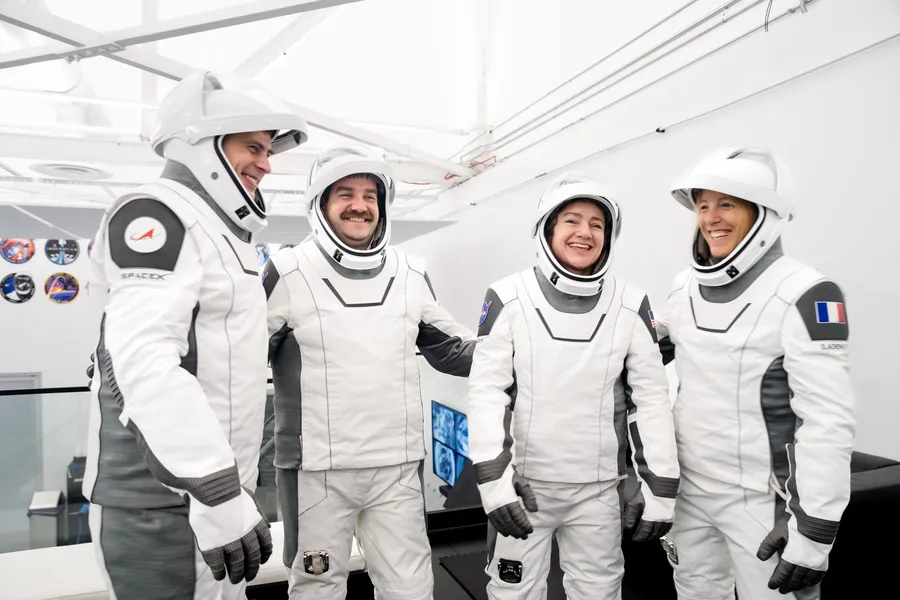
Four Astronauts Arrive at ISS Following January Medical Crisis The International Space Station welcomed four new crew members on February 14, 2026, restoring full operational capacity after a January medical emergency forced an unprecedented evacuation. The arrival of NASA astronauts Jessica Meir and Jack Hathaway, France's Sophie Adenot, and Russia's Andrei Fedyaev marks a critical milestone in stabilizing ongoing research operations aboard humanity's orbital laboratory. This crew rotation comes just weeks after NASA executed its first medical evacuation in the agency's 65-year history of crewed spaceflight—a sobering reminder that the ISS, despite decades of operational refinement, remains a high-risk environment where human health can deteriorate rapidly. In early January, one astronaut aboard the station developed a serious medical condition requiring immediate evacuation. Rather than attempt treatment in microgravity, mission control authorized the evacuation of that crew member plus three others, leaving the ISS temporarily staffed with only three astronauts and forcing the postponement of critical spacewalks and research activities. A Watershed Moment for Space Operations The January evacuation represents a pivotal inflection point in ISS operations. While medical emergencies have occurred during long-duration spaceflights before—Russian cosmonaut Valentin Lebedev famously suffered severe decompression sickness aboard Mir in 1989—this marks the first time NASA has had to execute a full crew evacuation response in its modern spaceflight era. The incident exposed vulnerabilities in the station's staffing model and prompted rapid reassessment of contingency protocols across all partner agencies: NASA, Roscosmos, ESA, and JAXA. Pre-flight medical screening, while rigorous, cannot predict all in-flight health complications. Long-duration microgravity exposure introduces physiological stressors—fluid shifts, bone density loss, cardiovascular deconditioning, and immune suppression—that compound over weeks and months. The incident underscores why the ISS operates on a 6-person minimum crew model and maintains strict rotation schedules. It also explains NASA's investment in rapid-turnaround crew launch systems like SpaceX's Crew Dragon, which can reach the station within 24 hours of launch. The New Team Brings Diverse Expertise The four arriving astronauts represent a constellation of specialization. Jessica Meir, making her second ISS flight, is a marine biologist who participated in the first all-female spacewalk in 2020 and has conducted extensive research on how microgravity affects living systems. Jack Hathaway, a U.S. Navy captain, brings command-level experience and leadership credentials essential during operations under stress. Sophie Adenot, France's second woman in space, is a military helicopter pilot whose aeronautical background adds critical systems expertise for maintaining the station's complex hardware. Andrei Fedyaev, a former Russian military pilot with prior ISS experience, provides continuity in Russian segment operations and redundancy in critical piloting and technical skills. This composition reflects the ISS's fundamental model: international cooperation where each agency contributes specialized talent. The station's complexity—with American, Russian, European, and Japanese modules operating under different protocols—demands crews with overlapping expertise and cross-training. What Comes Next The restored crew will immediately resume postponed research activities across biology, physics, materials science, and technology development. Spacewalks, which are among the station's highest-risk activities, will resume on a controlled schedule. Mission planners will continue analyzing the January evacuation to refine emergency protocols and ensure rapid crew rotation capabilities remain robust. The incident also likely accelerates development of on-orbit medical diagnostics and telemedicine capabilities to identify emergencies earlier and support treatment decisions in real time. For the broader spaceflight community, this moment reinforces a hard lesson: pushing deeper into space requires not just better technology, but better foresight about human vulnerability.

NASA races to fix Moon rocket before April launch window
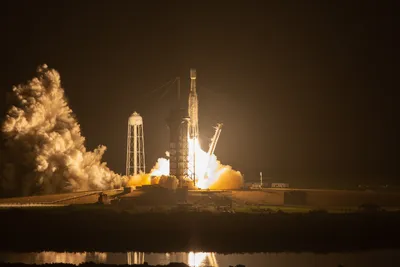
Artemis II Hits the Repair Bay NASA's Artemis II lunar rocket and Orion spacecraft rolled into the Vehicle Assembly Building on February 25, and technicians immediately went to work on a helium system malfunction that emerged during a recent test firing. Engineers traced the problem to the rocket's interim cryogenic propulsion system (ICPS) — the upper stage responsible for pushing the spacecraft toward the Moon — narrowing suspects to either a quick-disconnect seal or a check valve on the helium supply line. The issue surfaced during a wet dress rehearsal on February 21, when engineers were reconfiguring the rocket following a successful test. The helium system failure meant the upper stage couldn't be properly pressurized and conditioned for flight, a critical prerequisite before any Moon mission can launch. With an April launch window already on the calendar, the clock is ticking — but NASA engineers insist the timeline remains achievable if repairs proceed cleanly. Why Helium Matters to Moon Missions To non-engineers, helium might sound like party balloon filler. In reality, it's mission-critical infrastructure. The ICPS uses helium to maintain proper internal environmental conditions and to pressurize the upper stage tank for flight. Without adequate helium flow and pressure, the stage cannot function reliably once in space. The system connects through two umbilical interfaces: a forward plate (smaller) carrying liquid hydrogen vent and environmental control lines, and an aft plate (larger) supplying both liquid hydrogen and liquid oxygen, plus the helium quick-disconnect that's now suspect. The repair scope extends beyond just the helium problem. Teams are installing two sets of internal access platforms inside the launch vehicle stage adapter and removing thermal blankets to reach the problematic connection points. It's painstaking work — the kind that requires careful choreography and zero tolerance for error. Parallel Work Maximizes Schedule Efficiency While technicians tackle the helium issue, other crews are executing complementary repairs in parallel. NASA engineers have optimized the Vehicle Assembly Building work schedule to install new batteries across the SLS core stage, upper stage, and solid rocket boosters. The team will also retest the flight termination system — the rocket's safety kill switches — alongside avionics and control systems verification. The Orion spacecraft's launch abort system batteries will be recharged, and crews may refresh stowed items in the crew module. This multi-workstream approach is standard practice for large-scale vehicle processing, but it only works if the primary repair — in this case, the helium system fix — doesn't cascade into secondary problems. NASA has budgeted flexibility into the timeline, but each discovered issue compounds schedule risk. The April Window and Beyond NASA has publicly committed to an April launch opportunity for Artemis II, pending successful completion of data reviews, repairs, and system retests. The rocket will need to roll back to Launch Pad 39B in time to meet that window. If repairs extend beyond a few weeks, or if the investigation uncovers additional issues with the ICPS, the launch could slip to later availability windows. The Artemis II mission represents a crucial stepping stone for the broader lunar program — a crewed test flight of the SLS and Orion before the actual Moon landing attempt. Any delay ripples through the entire architecture. Yet rushing repairs on a vehicle bound for human spaceflight is never the answer. NASA will move methodically through diagnostics and fixes. The real deadline isn't April; it's mission success.
Satellite Mega-Constellations Turn Skies Into Crematoriums
The Space Industry's Dirty Secret: Burning Satellites Are Reshaping Earth's Atmosphere The satellite industry is expanding at a pace that may be fundamentally altering Earth's upper atmosphere in ways we're only beginning to understand. A new analysis from The Conversation warns that as mega-constellations like SpaceX's Starlink deploy thousands of massive satellites into orbit, the sheer volume of dead spacecraft burning up during atmospheric reentry could pose serious risks to climate, safety, and human culture—with little regulatory oversight currently in place. Nearly 15,000 active satellites now orbit Earth, with that number expected to grow to the millions within the next decade. Most belong to mega-constellations designed with service lives measured in just a few years. When these systems age, operators must launch replacements rapidly, creating a cycle of accelerating launches and reentries that is fundamentally reshaping orbital operations. The Weight Problem: Bigger Satellites, Bigger Consequences Perhaps the most overlooked variable in this expansion is satellite mass. Early-generation mega-constellation vehicles were relatively small. Today's Starlink V2 "mini" satellites weigh approximately 800 kilograms—equivalent to a fully loaded vehicle. Planned V3 variants will approach the mass of a commercial airliner. This matters immensely. Larger satellites produce more debris upon reentry, release greater quantities of pollutants into the stratosphere and mesosphere, and their particles remain suspended in the atmosphere longer than smaller predecessors. When thousands of 1,200-kilogram spacecraft burn up annually instead of dozens of 100-kilogram ones, the atmospheric chemistry equation changes. Researchers warn that accumulated metallic particles could accelerate ozone depletion and potentially disrupt weather patterns in ways we cannot yet predict. A 40 Percent Casualty Risk Per Five-Year Cycle The ground risk is immediate and quantifiable. Not all reentering satellites fully ablate. Larger fragments survive atmospheric passage and strike Earth. Current modeling suggests a 40 percent probability of at least one casualty per five-year cycle from mega-constellation reentries alone—a calculation that climbs as constellation sizes expand. This is no longer theoretical. SpaceX debris has already struck populated areas in Australia. As launch cadences accelerate and satellite mass increases, these incidents will multiply. The risk extends beyond civilians to aviation safety; aircraft operating at cruise altitude now share airspace with falling debris that neither pilots nor air traffic control can reliably track. The Night Sky Casualty We Didn't Plan For Meanwhile, astronomers and cultural heritage advocates warn of an invisible cost. Simulations show that millions of satellites will render the night sky artificial—thousands of visible objects replacing stars in the view available to naked-eye observers worldwide. For scientific astronomy, this degrades observational capability and wastes telescope time filtering out constellations. For indigenous cultures that have used stars for navigation, storytelling, and seasonal calendars for millennia, it represents permanent erasure of a heritage spanning human civilization. The Regulatory Vacuum No international framework currently governs atmospheric pollution from satellite reentry. No caps exist on constellation size. No penalties attach to operators who deploy massive satellites with poor deorbit planning. The industry is effectively running an uncontrolled experiment on Earth's upper atmosphere using the planet as a test subject. What's Next The research points to an urgent need for binding international agreements on satellite design standards, reentry protocols, and constellation size limits. Without intervention within the next 18-24 months—before mega-constellation deployments reach truly massive scale—atmospheric scientists warn we may lock in decades of unintended climate forcing from satellite reentry products. The question is no longer whether regulation will come, but whether it will arrive before the damage becomes irreversible.
We're finally close to spotting alien moons orbiting distant worlds
The Hunt for Worlds Beyond Planets For decades, astronomers have been finding exoplanets by the thousands. Yet despite discovering over 5,000 worlds orbiting distant stars, they've confirmed zero exomoons and zero exorings. That dry spell may be ending. Recent advances in detection technology and new observational techniques are bringing the first confirmed exomoon within reach—a milestone that could reshape our understanding of planetary system architecture across the galaxy. The challenge is fundamental: exomoons orbit planets that orbit stars light-years away. They're too faint and too close to their host planets to image directly with current telescopes. But astronomers have developed clever indirect methods to hunt for them, and the results are tantalizing. Following the Shadows The most established technique exploits the transit method—the same approach that identified most known exoplanets. When a planet passes in front of its star from our vantage point, the star dims slightly. An orbiting moon should create subtle asymmetries in this brightness dip, distorting the expected U- or V-shaped curve that astronomers plot over time. Kepler-1625b offers a prime example. Discovered in 2016, this super-Jupiter (a world with the mass of roughly a dozen Jupiters) showed odd bumps in its light curve that astronomers attributed to a massive exomoon—one roughly Neptune-sized, orbiting its host planet. Since then, the evidence has proven controversial, with competing papers arguing for and against its existence. It remains a candidate, not yet confirmed. Other detection methods are gaining traction. Transit timing variations measure subtle shifts in when and how long planetary transits occur, caused by the gravitational tug of orbiting moons. Astrometry—measuring the precise position and wobble of planets across the sky—offers another avenue. The GRAVITY instrument on the Very Large Telescope in Chile recently detected borderline evidence for a massive companion around HD 206893 B, a brown dwarf about 20 times Jupiter's mass. If real, this "moon" would orbit every nine months and carry roughly half Jupiter's mass. A Hot New Method: Following the Volcanoes Perhaps most intriguingly, astronomers are now hunting exomoons through volcanic activity—inspired by Jupiter's Io, which erupts constantly as the giant planet's gravity heats its interior. Using the James Webb Space Telescope and other observatories, researchers detected fluctuating sulfur dioxide clouds around the exoplanet WASP-39b and near WASP-49Ab, suggesting potential eruptions from tidally heated exomoons that might rival Io in ferocity. These detections aren't conclusive, but they signal a new pathway opening up. Unlike direct imaging, which remains impractical, these methods exploit the physical consequences of exomoon existence—transits, gravitational wobbles, thermal signatures—making detection feasible with instruments already in the sky. What About Rings? Exorings, while seemingly simpler to detect given their large area and brightness, present unexpected challenges. They can fade or align edge-on relative to our vantage point, making them temporarily invisible even if present around many exoplanets. What's Next The next critical milestone arrives with GRAVITY+, a sharper-eyed upgrade currently in testing. This enhanced instrument should definitively confirm or rule out the HD 206893 B companion within the next few years. Meanwhile, continued JWST observations and transit data from missions like TESS will accumulate evidence for other candidates. Within five years, astronomers expect to confirm the first exomoon—a watershed moment that will prove moons and rings are as common around distant planets as they are in our own solar system.
Russia establishes drone research centers, signals autonomous systems pivot
Putin Orders Major Drone Testing Infrastructure Buildout Russia is establishing dedicated research centers and testing sites for unmanned aerial systems across the country, following a presidential directive issued this week. The move signals a strategic pivot toward developing domestic autonomous systems capabilities, with the Kremlin expecting progress reports every six months starting in June 2026. According to a decree published by the Russian government, the infrastructure buildout will include specialized facilities for certifying different classes of autonomous systems—from small commercial drones to larger military and industrial platforms. The government has been tasked with determining funding sources and levels for the initiative, suggesting this is a resourced, long-term commitment rather than aspirational policy. Why This Matters for the Industry The timing and scope of Russia's directive reflect growing global competition in autonomous systems development. While Western nations—particularly the U.S., Israel, and European powers—have invested heavily in drone R&D over the past two decades, Russia has historically lagged in civilian autonomous systems integration, relying instead on imported or reverse-engineered platforms. This centralized push for testing infrastructure suggests Russia aims to accelerate domestic design, certification, and production cycles. The emphasis on "research centers" for each system type indicates an attempt to create specialized expertise hubs rather than a single monolithic facility—a model similar to how aerospace development is distributed across multiple design bureaus in Russia's traditional space and defense sectors. The directive also references easing regulatory requirements for drone operators performing work for "their own needs," suggesting parallel efforts to liberalize the civilian drone market. This two-track approach—tightening state control over testing infrastructure while loosening operator restrictions—mirrors strategies adopted by China and is designed to stimulate both commercial markets and state capability development simultaneously. Context: The Autonomous Systems Race Global drone markets are projected to exceed $50 billion annually by 2030, driven by applications in agriculture, infrastructure inspection, logistics, and defense. The U.S. maintains technological superiority in advanced autonomous systems, but China has captured significant market share in affordable commercial platforms. Russia has competed primarily in the defense segment, with mixed results in international sales. Establishing dedicated testing and certification infrastructure is essential for any nation seeking indigenous drone production at scale. Without standardized testing protocols and certified facilities, platforms cannot meet international export standards or integrate effectively into military operations. The fact that Russia is formalizing this infrastructure now suggests recognition that ad-hoc development and testing have become insufficient. What Comes Next Watch for announcements regarding which research institutions will lead these centers—likely candidates include the Moscow Aviation Institute, existing defense contractors like Kalashnikov Concern, and specialized unmanned systems firms. The June 2026 progress report deadline will be telling: whether centers are actually operational or still in planning phases will indicate how serious this push is. The broader implication is that Russia is preparing for a long-term competition in autonomous systems, allocating resources comparable to what it dedicates to other strategic technologies. For international observers and industry analysts, this represents another data point in the ongoing reconfiguration of technology competition along geopolitical lines—where autonomous systems, like semiconductor manufacturing and artificial intelligence, are increasingly treated as strategic national assets rather than purely commercial technologies.
Moon's magnetic field solved: rare bursts, not constant.
Ancient Mystery Finally Cracked For decades, planetary scientists have been locked in a fundamental debate about the moon's early history: Did Earth's satellite once generate a powerful magnetic field or a weak one? A new study from the University of Oxford published in Nature Geoscience this week suggests the answer is both—and the resolution hinges on a decades-old sampling mistake. The moon today is magnetically inert. Yet many rock samples brought back by NASA's Apollo missions display strong evidence of magnetism, implying the young moon hosted a vigorous internal dynamo capable of generating a global magnetic field comparable to or stronger than Earth's today. But this created a theoretical headache: the moon is relatively small. The physics of planetary cooling suggested it couldn't sustain such intense magnetism for hundreds of millions of years. An alternative camp argued the moon's core only produced a weak baseline field, with asteroid impacts occasionally amplifying it temporarily. The Sampling Bias That Changed Everything Oxford researchers, led by associate professor Claire Nichols, revisited Apollo rock samples and discovered the entire decades-long disagreement stemmed from where NASA chose to land. All six Apollo missions touched down in relatively flat, dark plains called mare regions—volcanic plains rich in specific rock types that, as it turns out, preferentially recorded rare magnetic events. "Our new study suggests that the Apollo samples are biased to extremely rare events that lasted a few thousand years—but up to now, these have been interpreted as representing 0.5 billion years of lunar history," Nichols said. The team identified a clear chemical signature: rocks recording strong magnetic fields contained high levels of titanium, while those recording weak fields had low titanium content. This link between titanium-rich volcanism and intense magnetism proved transformative. The new model proposes that for the vast majority of the moon's early history—between 3.5 and 4 billion years ago—the lunar magnetic field was weak. But during rare, fleeting windows lasting only a few thousand years (possibly even just decades), melting of titanium-rich rocks at the moon's core-mantle boundary generated temporary pulses of extremely strong magnetism. Computer models confirmed that random sampling of the lunar surface would have missed these spikes almost entirely, validating the bias hypothesis. Why This Matters Beyond Lunar Science Understanding the moon's magnetic past is more than academic curiosity. Magnetic fields shield planetary surfaces from solar wind, a crucial factor in whether worlds retain atmospheres. By pinpointing when and how the moon's dynamo operated, scientists gain insight into core cooling, mantle evolution, and why lunar geological activity faded. The findings also illuminate a profound contrast: Earth's magnetic field remains robust today, while the moon's vanished. Some researchers speculate the moon's ancient magnetosphere may have even interacted with Earth's early magnetic environment, potentially influencing how our planet retained its protective atmosphere—a cascading effect across the inner solar system. What Comes Next The research arrives as NASA prepares the Artemis program to explore new lunar regions beyond the traditional mare landing zones. These missions will provide the first opportunity to test the Oxford team's predictions directly, sampling regions that should reveal weaker magnetic signatures and validate the rare-spike hypothesis. For lunar scientists, the next few years of sample analysis could either cement this framework or reveal new surprises about how planetary dynamos operate on worlds far smaller than Earth.

Lost Soviet Scientist Proves the Sun Rules Your Body
The Forgotten Prophet of Solar Biology In 1924, a Russian scientist named Alexander Chizhevsky made a claim so audacious that it would haunt him for the rest of his life: the Sun doesn't just warm the Earth—it synchronizes human biology, behavior, and even history itself. Almost a century later, modern research is proving he was onto something profound. Chizhevsky (1897–1964) was a polymath in an era when that term still meant something. He was a poet, inventor, and natural philosopher who noticed patterns others had missed. While studying historical records of major wars, revolutions, and social upheavals, he observed something striking: they clustered during periods of intense solar activity. He published his findings in "Physical Factors of the Historical Process" (1924) and later expanded his theory in works like "The Terrestrial Echo of Solar Storms" (1936). His thesis was revolutionary and controversial: the Sun's 11-year activity cycle left an imprint on human civilization itself. A Career Derailed by an Idea Too Big Chizhevsky's misfortune was timing and geography. Working in Stalin's Soviet Union, he became a victim of ideological purges that viewed his work as pseudoscience. Despite his extraordinary contributions to electrobiology and atmospheric ionization research, he spent years in exile and was largely written out of scientific history in the West. For decades, heliobiology—the study of solar influences on biological systems—became a whispered field, relegated to the fringes of respectable science. But science has a long memory. By the 1990s, researchers building on Chizhevsky's foundational work began documenting measurable links between solar activity and human physiology. Studies showed correlations between solar storms and variations in heart rate variability, blood pressure, and even immune function. The connections weren't magical; they were physical—solar activity drives changes in Earth's magnetosphere and cosmic ray flux, which influence electrical properties in living organisms. His intuition had been scientifically sound all along. Modern Validation: The Science Catches Up Today, Chizhevsky is recognized as the undisputed pioneer of heliobiology. Academic works like "Solar Activity & The Biosphere: Heliobiology. From A.L. Chizhevsky To The Present" (edited by Boris M. Vladimirsky and colleagues, 1999) explicitly trace the field's genealogy back to him, cataloging over 500 peer-reviewed papers that validate his core insights. Researchers have confirmed that geomagnetic storms correlate with measurable changes in human circadian rhythms, hemodynamics, and neurological function. Solar cycles influence everything from birth rates to mood disorders to hospital admissions for specific conditions. The irony is delicious: a man persecuted for ideas that seemed too strange to be true spent his final decades vindicated by the very scientific method his critics invoked to dismiss him. The Next Frontier: Personal Heliobiology Chizhevsky's legacy is about to enter the personal health space in a tangible way. Perihelion is developing Heliobios, an iOS app launching soon (with Android to follow) that bridges the gap between solar data and individual biometrics. The app integrates directly with Apple HealthKit and Oura ring data at launch, allowing users to track correlations between solar activity and their own physiological responses—heart rate variability, sleep quality, stress levels, and more. Additional integrations are planned as the platform matures. Heliobios represents the democratization of a field Chizhevsky pioneered alone: giving individuals the tools to understand their own solar biology. Visit Heliobios.com to learn more and sign up for launch notifications. Chizhevsky would have marveled at the idea. The Sun, he believed, was not a distant furnace but a fundamental organizing principle of life itself. Now, finally, the data is catching up to his vision.

Sun Goes Spotless for First Time in Three Years
The Sun Just Hit Pause For the first time since June 2022, the sun's surface went completely blank on February 22, 2026. No sunspots. No magnetic turbulence. No dark, cooler patches that typically herald incoming solar storms. The observation marks a rare moment of calm on our star's perpetually restless surface—but it lasted only days before new activity resumed. The spotless day, recorded by NASA's Solar Dynamics Observatory, arrived as the sun enters what scientists call the declining phase of its 25th solar cycle. While brief, this moment offers a window into the machinery of solar weather and what Earth can expect in the coming years. Why Sunspots Matter Sunspots aren't cosmetic features. They're windows into the sun's magnetic violence. These cooler, darker patches form where extraordinarily strong magnetic fields—tens of thousands of times stronger than Earth's—prevent heat from rising to the surface. More importantly, they signal danger. Where there are sunspots, solar flares and coronal mass ejections (CMEs) tend to follow. These eruptions hurl billions of tons of plasma into space. When that plasma reaches Earth, it buffets our magnetosphere, triggering geomagnetic storms that disrupt satellite communications, GPS navigation, and electrical grids. During the current cycle's peak in 2024, such events became frequent enough to make headlines and trigger emergency protocols in critical infrastructure sectors. Conversely, when sunspots vanish, solar violence typically subsides. February's spotless observation suggests the sun is winding down from its peak, a cyclical process as reliable as seasons on Earth. The 11-Year Rhythm The sun operates on an 11-year heartbeat. Activity rises and falls in a predictable oscillation, with sunspot density peaking around the middle of each cycle and bottoming out during the solar minimum. The current cycle peaked in 2024, meaning we're now in the declining phase—but scientists caution we're not there yet. Historically, solar minimums are profound. Between 2018 and 2020, during the last minimum, the sun went spotless for over 700 days total—entire weeks without visible magnetic activity. The next solar minimum is expected around 2030, still four years away. That means the sun likely has more volatility ahead before settling into its quiet years. But here's the nuance: even during minimums, sporadic sunspots and flares can erupt. Quieter doesn't mean silent. It means fewer disruptions, on average, and more predictable space weather patterns. What February's Lull Reveals The fact that sunspots reappeared by February 24 demonstrates the sun isn't fully committed to shutdown yet. This brief spotlight-free window was more symbolism than substance—a data point in the larger narrative rather than a turning point. For space operators, satellite engineers, and power grid managers, February's observation serves as a reminder: we're transitioning from a period of elevated risk toward calmer conditions. Solar activity forecasts for the next four years will trend downward. That's good news for infrastructure stability and bad news for aurora photographers hoping for more show-stopping northern lights displays. Scientists continue monitoring the sun's surface daily, tracking sunspot emergence and solar flare activity. These observations feed into models that help industry prepare for space weather events and, conversely, anticipate periods when our orbit becomes safer. What's Next Watch for the frequency of spotless days to increase over the coming months and years as solar minimum approaches. By 2028–2030, extended weeks without visible sunspots should become the norm. Meanwhile, any major solar events between now and then will likely be isolated outbursts rather than sustained activity—the sun's final gasps before settling in for a quieter era.
Explore full coverage by segment
Live Space Weather Data
Real-time monitoring from NOAA SWPC, satellite feeds, and orbital tracking
View Live Dashboard