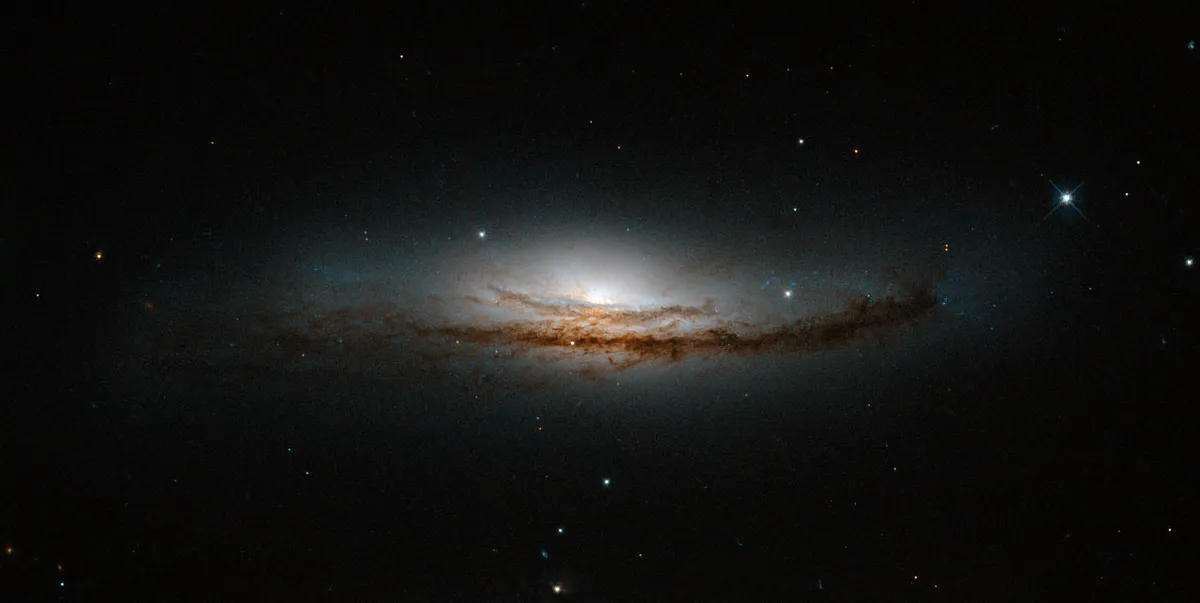
A Cosmic Accident Reveals Nature's Most Powerful Microwave Laser
Astronomers have detected the brightest microwave laser ever observed, emanating from a galaxy called H1429-0028 located nearly 8 billion light-years from Earth. The discovery, made using South Africa's MeerKAT radio telescope array, represents both a scientific windfall and a stroke of serendipity—researchers stumbled upon the phenomenon while hunting for something else entirely.
The signal was so unexpectedly strong that Roger Deane of the University of Pretoria described the moment of detection as jaw-dropping. "We had a quick look at the 1667 megahertz frequency, just to see whether it was even detectable, and there was this booming, huge signal," Deane recalls. "It was immediately the record. It was serendipitous."
How Nature Built the Universe's Most Powerful Maser
The phenomenon underlying this discovery is called a maser—short for "microwave amplification by stimulated emission of radiation." Unlike visible lasers found in laboratories and consumer devices, masers operate at microwave frequencies and occur naturally in space under extreme conditions.
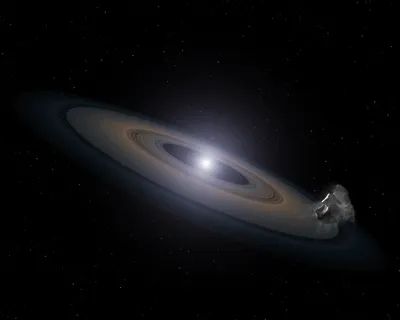
Masers form when atoms or ions are stimulated into high-energy states, then bombarded with photons that trigger them to relax in unison. Because each atom emits identical photons, the result is coherent radiation—light all at the same frequency, traveling in a tight beam. In this case, the culprit is hydroxyl ions (consisting of hydrogen and oxygen atoms), excited by the violent collision of two merging galaxies. When blasted by radio waves from a supermassive black hole, these ions suddenly relax, producing an extraordinarily bright and focused beam of microwave radiation.
The system achieves its extraordinary brightness—approximately 100,000 times the luminosity of our Sun, concentrated into an impossibly narrow slice of the electromagnetic spectrum—because the light from galaxy H1429-0028 is magnified by gravitational lensing. A massive galaxy between H1429-0028 and Earth warps spacetime itself, acting as a cosmic magnifying glass that amplifies the signal reaching our telescopes.
A Phenomenon So Rare It Needs a New Name
Masers bright enough to be detected across such vast cosmic distances are classified as "gigamasers"—a tier of magnitude far beyond the "megamasers" observed in nearby galactic collisions. The sheer power of this discovery suggests that such phenomena may be more common in the distant universe than previously suspected, though detecting them requires instrumental sensitivity that only recently became available.
The MeerKAT telescope array, consisting of 64 linked radio dishes operating as a single instrument, proved ideal for this discovery. Its design mirrors principles now being scaled up for the Square Kilometre Array (SKA), an international megaproject under construction in South Africa and Australia that will dwarf MeerKAT in both sensitivity and collecting area.
What This Means for Studying Galaxy Evolution
Beyond the spectacular nature of the discovery, gigamasers like H1429-0028 offer astronomers a precise tool for studying how galaxies merged in the early universe. Masers require extraordinarily specific conditions to form: active star formation heating dust to high temperatures, radio continuum emission from supermassive black holes, and the violent collision of two galaxies. This makes them reliable tracers of galactic mergers stretching back toward the universe's infancy.
When the Square Kilometre Array comes online within the next few years, astronomers expect to detect similar masers at even greater distances, effectively reading the merger history of some of the first galaxies ever formed. Each detection brings us closer to understanding how the cosmos assembled itself over the past 13.8 billion years.