Discovery Upends Planet Formation Models
Astronomers have discovered a planetary system that breaks one of astronomy's most reliable rules: rocky planets belong close to stars, and gas giants far away. The finding, published today in Science and led by McMaster University's Prof. Ryan Cloutier, challenges decades of planet-formation theory and suggests the universe builds worlds in far more creative ways than scientists assumed.
The culprit is LHS 1903 e, a rocky planet orbiting in the outer reaches of a four-planet system around a red dwarf star just 26 light-years away. It shouldn't be there. According to well-established models, intense radiation from a host star should strip away any gas near the inner planets, leaving bare rock. Farther out, cooler conditions allow thick atmospheres to accumulate, forming gas giants. Our own solar system follows this blueprint perfectly. But LHS 1903 breaks the pattern: three planets orbit as expected (one rocky inner world, two miniature Neptunes), then comes a fourth rocky planet in the outer system where a gas giant should logically reside.
The Pattern Everyone Thought Was Universal
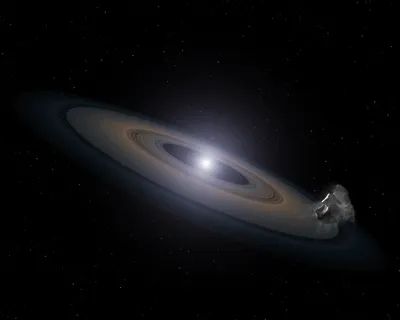
For decades, this orbital architecture—rocky-in, gaseous-out—has held across hundreds of observed exoplanetary systems. It's one of astronomy's few clean, predictive rules. The theoretical foundation is sound: as planets form within a swirling disk of gas and dust around a newborn star, the star's radiation gradually photoevaporates the disk. Close-in planets lose their atmospheres before they can grow massive; distant planets accumulate thick envelopes of hydrogen and helium before the disk disperses.
This model explains why Jupiter and Saturn, positioned far from our Sun, became gas and ice giants, while Mercury, Venus, Earth, and Mars remained rocky terrestrial worlds. It's one of the few aspects of planetary science where observation and theory aligned neatly.
Until now.
A New Mechanism: Sequential Planet Birth
To uncover how LHS 1903 e could form as a rocky world in an environment hostile to such bodies, the international team—co-led by the University of Warwick's Prof. Thomas Wilson—tested and eliminated competing hypotheses. Could a massive collision have stripped the planet's atmosphere? Orbital simulations ruled it out. Could planetary migration have reshuffled the system's architecture? The numbers didn't work. Could planets have formed out of sequence?
That last possibility gained traction. The team's analysis points toward inside-out planet formation: rather than all planets assembling simultaneously within a protoplanetary disk, they may have formed one after another, each under evolving disk conditions. By the time LHS 1903 e began coalescing, the disk surrounding the star may have already been depleted of the gas required to build a thick atmosphere. The planet was essentially born into an already-ransacked neighborhood.
This mechanism is not new in theory but has rarely been invoked to explain observational data with such clarity. It transforms planet formation from a simultaneous, predictable process into a sequential, context-dependent one—a far messier universe than models suggested.
What This Means for Exoplanet Science
Cloutier notes that LHS 1903 could represent either an anomaly or the first observation of a widespread pattern scientists have overlooked. As detection methods improve—particularly space-based telescopes like the European Space Agency's CHEOPS satellite, which first revealed LHS 1903 e—astronomers will systematically catalogue planetary systems that don't match textbook expectations.
The implications extend beyond this single system. If sequential formation is common, current exoplanet discovery pipelines may need revision. Models trained on solar-system assumptions will require substantial recalibration. And the diversity of planetary architectures across the galaxy may be far greater than catalogues currently suggest.
The next phase involves follow-up observations to confirm LHS 1903 e's composition and refine atmospheric constraints. As telescopes sharpen and sample sizes grow, the question shifts from "Why is LHS 1903 different?" to "How many planetary systems have we misunderstood because they didn't fit our templates?"
In planetary science, anomalies often become the doorway to discovery.