Discovery #discoveries · International (NASA/ESA/CSA) February 21, 2026

Webb reveals Uranus's auroras in stunning 3D detail

Published 6 days ago
Quality
80%
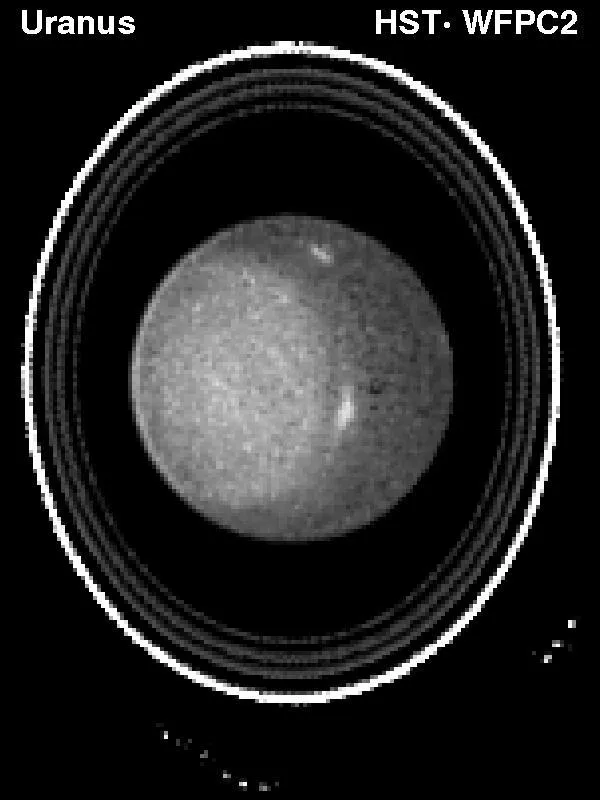
Hubble Observes the Planet Uranus
NASA / JPL

Webb reveals Uranus's auroras in stunning 3D detail

Webb's First True Look Into Uranus's Vertical Atmosphere

The James Webb Space Telescope has achieved a scientific first: mapping the three-dimensional structure of auroras dancing above Uranus, revealing how energy flows vertically through the ice giant's upper atmosphere. Using the Near-Infrared Spectrograph (NIRSpec) instrument, an international research team observed how temperature and charged particles vary with height across the planet as it rotated, producing unprecedented detail about one of the solar system's most peculiar worlds.

The findings, published February 19 in Geophysical Research Letters, show two bright auroral bands near Uranus's magnetic poles, along with regions of reduced emission and ion density—features likely tied to the planet's notoriously lopsided magnetic field. "Uranus's magnetosphere is one of the strangest in the solar system," explained Paola Tiranti of Northumbria University. "It's tilted and offset from the planet's rotation axis, which means its auroras sweep across the surface in complex ways."

Why This Matters Now

This discovery arrives at a critical juncture in exoplanet science. As astronomers discover ice giants orbiting distant stars, understanding how energy behaves in Uranus's upper atmosphere becomes a crucial laboratory for characterizing similar worlds elsewhere. "By revealing Uranus's vertical structure in such detail, Webb is helping us understand the energy balance of the ice giants," Tiranti said. "This is a crucial step towards characterizing giant planets beyond our solar system."

The work extends a decades-long conversation about Uranus itself. When Voyager 2 flew past in 1986, it revealed Uranus as the solar system's coldest planet—a finding that has only deepened. Webb's latest observations confirm the upper atmosphere has continued cooling since measurements began in the early 1990s, with average temperatures hovering around 426 kelvins (approximately 150 degrees Celsius). That's significantly lower than readings from ground-based telescopes or previous spacecraft, suggesting Uranus is undergoing a long-term atmospheric shift.

The Technical Breakthrough

What makes this observation genuinely novel isn't just the data—it's the dimensional insight. Previous observations could measure Uranus's auroral brightness or chemical composition, but NIRSpec's infrared spectroscopy allows scientists to trace how temperature and particle density change with altitude across the entire planet. This vertical profiling reveals the mechanisms by which energy enters the upper atmosphere from below and is distributed through magnetic field interactions.

The two auroral bands and the distinctive emission gap between them tell a story about how Uranus's skewed magnetic field—tilted 59 degrees from its rotation axis—channels energetic particles into asymmetrical patterns. This is fundamentally different from Earth's or Jupiter's more orderly auroral systems, making Uranus a natural laboratory for understanding exotic magnetospheric physics.

What Comes Next

Webb's continued focus on Uranus signals that ice giants are no longer the solar system's forgotten cousins. The telescope's discovery of a new Uranus moon in 2025 already demonstrated the instrument's power to surprise, and this auroral study sets the stage for deeper investigation into atmospheric dynamics. Future observations could map seasonal changes, track long-term cooling trends, or search for subtle composition variations tied to magnetic field geometry. As Webb accumulates more data on ice giants, the comparative framework for understanding exoplanet atmospheres grows measurably stronger—transforming a distant ice giant into humanity's closest analog for worlds we've yet to reach.
💡
Think of it like...

The temperature measured by Webb (426 kelvins) is roughly equivalent to the inside of a conventional kitchen oven set to 350°F—cold enough to liquefy most gases, and about 150°C colder than Earth's surface.

Related Entities

James Webb Space Telescope·satellite
NASA·agency
ESA·agency
CSA·agency
STScI·facility
Paola Tiranti·person
Northumbria University·facility
Uranus·vehicle
📍International (NASA/ESA/CSA)

Continue Reading

Image for: NASA's Twin Spacecraft Will Map Mars' Atmospheric Death
Space Weather1 day ago

NASA's Twin Spacecraft Will Map Mars' Atmospheric Death

NASA's Twin Spacecraft Will Map Mars' Atmospheric Death NASA's ESCAPADE mission has switched on its science instruments, marking the first operational phase of an unprecedented dual-spacecraft venture to understand how the Sun systematically stripped Mars of its once-habitable atmosphere. Launched November 13, 2025, aboard a Blue Origin New Glenn rocket, the two orbiters are currently looping around Lagrange Point 2—a gravitational waystation 1 million miles from Earth—before executing a gravity-assisted maneuver off our planet in November 2026 to reach Mars in September 2027. The mission arrives at a critical moment for Mars exploration. While robotic rovers have mapped the planet's surface for decades, ESCAPADE represents the first coordinated two-spacecraft investigation of Mars' magnetosphere and the solar wind processes that have transformed the Red Planet from a warm, wet world into a frozen desert over billions of years. "Having two spacecraft is going to help us understand cause and effect," said Michele Cash, ESCAPADE program scientist at NASA Headquarters. This stereo perspective—simultaneous measurements from two vantage points—will reveal how the solar wind interacts with Mars' magnetic field and drives atmospheric escape in real time. Why Mars Lost Its Atmosphere (And Why That Matters for Human Missions) Mars once possessed a dense atmosphere and a robust global magnetic field capable of deflecting the Sun's relentless particle stream. Today, the Red Planet's magnetosphere is a patchwork: remnants of ancient crustal magnetism combined with a weaker, induced field generated by solar wind interactions with charged particles in the upper atmosphere. This "hybrid" magnetosphere provides minimal protection against solar radiation—a critical liability for future human explorers. Understanding this process isn't merely academic. Before NASA sends astronauts to Mars, engineers must quantify radiation exposure on the surface and develop shielding protocols for habitats. ESCAPADE will also characterize Mars' ionosphere, the electrically charged upper atmosphere layer that future missions will rely on for radio communications and navigation systems. "If we ever want GPS at Mars or long-distance communications, we need to understand the ionosphere," said Rob Lillis, the mission's principal investigator at UC Berkeley. A New Approach to Mars Trajectory ESCADADE showcases a paradigm shift in deep-space mission planning. Traditional Mars launches required Earth-Mars orbital alignment—a constraint that restricted launch windows to every 26 months. By adopting a "loiter" orbit around Lagrange Point 2, ESCAPADE decouples launch timing from planetary mechanics, enabling missions to depart Earth almost on demand. During this extended loop, the twin spacecraft will traverse an unexplored region of Earth's distant magnetotail, approximately 1.2 million miles from our planet, collecting the first direct measurements of this region's plasma and magnetic field properties. Technical Innovation: Stereo Magnetosphere Monitoring Once in Mars orbit, ESCAPADE's dual-spacecraft architecture enables groundbreaking measurements. For the mission's first six months, the orbiters will follow identical orbital paths, passing over the same magnetic features at different times. This configuration allows detection of magnetosphere variations on timescales as short as two minutes—previously impossible with single-spacecraft missions. After six months, one spacecraft will climb to higher altitude while the other remains closer to Mars, enabling simultaneous upstream solar wind measurements and magnetosphere monitoring. "Prior spacecraft could either be in the upstream solar wind, or they could be close to the planet," Lillis noted. "ESCAPADE allows us to be in two places at once and measure the cause and the effect." What's Next The spacecraft will arrive at Mars in September 2027, initiating a multi-year science campaign timed to inform NASA's Human Exploration and Operations Mission Directorate planning for crewed missions. ESCAPADE's data will directly feed into radiation protection standards, landing site selection, and life support system requirements for Mars exploration. The mission's success could validate the Lagrange Point loiter trajectory as a standard approach for future deep-space missions, fundamentally reshaping how NASA schedules interplanetary exploration.

#space-weather
70%
NASA's SpaceX Crew-5 in space station mockups
Discovery1 day ago

NASA Just Made Moonlight into Breathable Air

The News NASA's Carbothermal Reduction Demonstration (CaRD) project has cleared a critical hurdle: successfully extracting oxygen from simulated lunar regolith using nothing but concentrated sunlight. The integrated prototype test, conducted aboard the International Space Station, confirmed that solar-driven chemistry can produce carbon monoxide from lunar soil—the essential first step toward generating breathable air for astronauts living on the Moon. This isn't theoretical anymore. It's hardware that works. Why This Matters Right Now The challenge facing long-duration lunar missions is brutally simple: you can't ship enough oxygen from Earth. Resupply missions are expensive, infrequent, and add massive weight to launch vehicles. For NASA's Artemis program to establish a sustainable lunar base—a cornerstone of the Moon-to-Mars architecture—the agency needs to generate life support resources on-site rather than hauling them across 240,000 miles of vacuum. CaRD solves this by turning lunar geology into life support. The Moon's regolith, the pulverized rock covering its surface, is approximately 45% oxygen by mass, locked inside silicate minerals. The catch: extracting it requires intense heat. CaRD uses a solar concentrator—essentially a sophisticated mirror array—to focus sunlight into a reactor hot enough to drive carbothermal reduction, the same chemistry used on Earth to refine metals from ore. The Technical Achievement The CaRD prototype integrates four major components: a carbothermal oxygen production reactor built by Sierra Space, a solar concentrator designed by NASA Glenn Research Center, precision mirrors from Composite Mirror Applications, and avionics and gas analysis systems from Kennedy Space Center. Johnson Space Center pulled the systems engineering together. During testing, they confirmed production of carbon monoxide (CO) from the regolith simulant—proof that the concept works in controlled conditions. The real power lies downstream: when CO is converted into O₂ using additional chemical processes already in development, the system could produce a steady oxygen supply for habitat life support, fuel cell operations, or even metallurgical processes. Why carbothermal reduction specifically? It's proven industrial chemistry, scalable, and—critically—it requires no chemical inputs that aren't already abundant on the Moon. Sunlight is the only external resource needed. What Comes Next The immediate path forward involves coupling this oxygen extraction with conversion technology to turn CO into usable O₂. Beyond the lunar south pole, NASA is already eyeing how to adapt CaRD for Mars, where the technology could extract oxygen from Martian regolith or even convert atmospheric CO₂ into propellant. The cost and logistics savings are staggering: reducing payload mass for human missions, decreasing launch frequency, and enabling crews to live off the land rather than Earth's supply chain. CaRD was funded by NASA's Game Changing Development program under the Space Technology Mission Directorate—signaling this is no longer moonshot research, but mainstream development. As Artemis missions ramp up in the coming years, technologies like this transition from "demonstration" to "flight hardware." The Moon just became a lot more hospitable.

#discoveries
70%
NASA's SpaceX Crew-5 in space station mockups
Anomalies1 day ago

China's Mars Sample Return Mission Threatens U.S. Leadership in Alien Life Hunt

The Rock That Changed Everything In July 2024, NASA's Perseverance rover discovered something that made planetary scientists collectively hold their breath: a Martian rock covered in peculiar markings—some resembling poppy seeds, others like leopard spots. On Earth, these biosignatures are almost exclusively produced by microbial life. While the discovery isn't definitive proof of ancient Martian biology, it represents humanity's best evidence yet that life might not be a cosmic anomaly. "If you do it, then human history is never the same," says Casey Dreier, chief of space policy at the Planetary Society. But there's a problem: those tantalizing rocks may never reach Earth. NASA's ambitious Mars Sample Return (MSR) mission—designed to retrieve pristine Martian samples for laboratory analysis—is effectively on life support. Congress has allocated zero funding for 2026, leaving the project with minimal backing and a clear path toward cancellation. After 50 years of preparation and billions invested, American planetary science finds itself two feet from the finish line with the gas running out. When American Leadership Meets Congressional Reality Mars Sample Return was conceived as a Rube Goldberg sequence of robotic missions: Perseverance would collect samples, hand them to a retrieval lander, which would launch them to orbit for Earth-bound transfer. It represented the crown jewel of U.S. Mars exploration and a logical stepping stone toward human missions. Yet the project fell victim to ballooning costs, technical complexity, and competing budgetary priorities. The timing couldn't be worse. While NASA struggles with funding uncertainty, China is moving "full steam ahead" with its own Mars sample return mission. The Chinese effort is leaner—and yes, the samples it retrieves will likely be lower quality—but it has something NASA currently lacks: momentum and committed resources. "At the rate we're going, there's a very good chance they'll do it before we do," laments Philip Christensen, a planetary scientist at Arizona State University. "Being there first is what matters." This isn't merely about scientific pride, though that stings. China establishing first contact with definitive evidence of extraterrestrial life would reshape geopolitical dynamics and scientific collaboration for decades. Beyond that, control over Mars sample analysis gives the first discoverer enormous leverage over future Martian research agendas. Why This Matters for Human Mars Missions Mars sample return isn't just about answering the 50-year-old Viking lander question about microbial life. It's a mandatory prerequisite for human Mars exploration. "If we can't do this, how do we think we're gonna send humans there and get back safely?" asks Victoria Hamilton, chair of the NASA-affiliated Mars Exploration Program Analysis Group. As fellow planetary scientist Paul Byrne puts it bluntly: "If you're going to bring humans back from Mars, you sure as shit have to figure out how to bring the samples back first." The technical challenges of sample retrieval—launching from the Martian surface, achieving Mars orbit rendezvous, and executing a pristine return trajectory to Earth—are precisely the systems NASA will need to master for crewed missions. Abandoning MSR doesn't just forfeit a scientific prize; it defers critical engineering development by years or decades. What's at Stake Mars remains an arid, radiation-scoured wasteland today. But billions of years ago, liquid water flowed across its surface under a protective magnetic field and thicker atmosphere. Beneath the modern surface, where shielded from cosmic radiation and warmer, microbial life might still persist. Sedimentary rocks—the type most likely to preserve fossils—require ground-based or robotic sampling. Martian meteorites that reach Earth are too damaged by radiation and atmospheric friction to yield reliable data. The scientific opportunity is genuine and narrow. Congress has a choice: fund the final act of a decades-long investigation, or watch another nation write the epilogue to humanity's greatest existential question. History suggests the world remembers who got there first.

#anomalies
70%
Image for: NASA races to fix Moon rocket before April launch window
Launch Ops1 day ago

NASA races to fix Moon rocket before April launch window

Artemis II Hits the Repair Bay NASA's Artemis II lunar rocket and Orion spacecraft rolled into the Vehicle Assembly Building on February 25, and technicians immediately went to work on a helium system malfunction that emerged during a recent test firing. Engineers traced the problem to the rocket's interim cryogenic propulsion system (ICPS) — the upper stage responsible for pushing the spacecraft toward the Moon — narrowing suspects to either a quick-disconnect seal or a check valve on the helium supply line. The issue surfaced during a wet dress rehearsal on February 21, when engineers were reconfiguring the rocket following a successful test. The helium system failure meant the upper stage couldn't be properly pressurized and conditioned for flight, a critical prerequisite before any Moon mission can launch. With an April launch window already on the calendar, the clock is ticking — but NASA engineers insist the timeline remains achievable if repairs proceed cleanly. Why Helium Matters to Moon Missions To non-engineers, helium might sound like party balloon filler. In reality, it's mission-critical infrastructure. The ICPS uses helium to maintain proper internal environmental conditions and to pressurize the upper stage tank for flight. Without adequate helium flow and pressure, the stage cannot function reliably once in space. The system connects through two umbilical interfaces: a forward plate (smaller) carrying liquid hydrogen vent and environmental control lines, and an aft plate (larger) supplying both liquid hydrogen and liquid oxygen, plus the helium quick-disconnect that's now suspect. The repair scope extends beyond just the helium problem. Teams are installing two sets of internal access platforms inside the launch vehicle stage adapter and removing thermal blankets to reach the problematic connection points. It's painstaking work — the kind that requires careful choreography and zero tolerance for error. Parallel Work Maximizes Schedule Efficiency While technicians tackle the helium issue, other crews are executing complementary repairs in parallel. NASA engineers have optimized the Vehicle Assembly Building work schedule to install new batteries across the SLS core stage, upper stage, and solid rocket boosters. The team will also retest the flight termination system — the rocket's safety kill switches — alongside avionics and control systems verification. The Orion spacecraft's launch abort system batteries will be recharged, and crews may refresh stowed items in the crew module. This multi-workstream approach is standard practice for large-scale vehicle processing, but it only works if the primary repair — in this case, the helium system fix — doesn't cascade into secondary problems. NASA has budgeted flexibility into the timeline, but each discovered issue compounds schedule risk. The April Window and Beyond NASA has publicly committed to an April launch opportunity for Artemis II, pending successful completion of data reviews, repairs, and system retests. The rocket will need to roll back to Launch Pad 39B in time to meet that window. If repairs extend beyond a few weeks, or if the investigation uncovers additional issues with the ICPS, the launch could slip to later availability windows. The Artemis II mission represents a crucial stepping stone for the broader lunar program — a crewed test flight of the SLS and Orion before the actual Moon landing attempt. Any delay ripples through the entire architecture. Yet rushing repairs on a vehicle bound for human spaceflight is never the answer. NASA will move methodically through diagnostics and fixes. The real deadline isn't April; it's mission success.

#launch-ops
70%
NASA's SpaceX Crew-5 in space station mockups
Innovation1 day ago

NASA grows yogurt in space to feed Mars astronauts

Yogurt Becomes a Tool for Deep Space Survival NASA has transformed the International Space Station into an orbital biotechnology lab, running experiments that could fundamentally change how humans feed themselves on the way to Mars. The agency's BioNutrients-3 experiment is testing whether astronauts can produce nutrient-dense fermented foods—yogurt and similar products—using beneficial microorganisms in the microgravity environment. Samples are being returned to Earth aboard SpaceX's Dragon spacecraft on February 26, 2026, for analysis at NASA's Ames Research Center in California. The mission addresses one of the hardest problems in long-duration spaceflight: keeping astronauts healthy when resupply missions are months or years away. Certain vitamins and nutrients critical for human health degrade in storage or become impractical to transport on multi-year journeys. Rather than storing massive quantities of food and supplements launched from Earth, NASA is betting that astronauts can become their own food producers—growing nutrients on-demand through controlled fermentation. Why Fermentation Works in Space Fermented foods like yogurt are produced through microbial action, a biological process that doesn't inherently depend on gravity. The BioNutrients-3 experiment uses the same fundamental biochemistry that creates these foods on Earth, but with a critical difference: it's happening in microgravity, where resources are finite and resupply windows are measured in years rather than weeks. The strategic advantage is significant. A crew en route to Mars—facing a mission duration of 18 to 24 months or longer—cannot rely on regular resupply from Earth. Self-sufficiency isn't optional; it's existential. By engineering microorganisms to produce essential nutrients through fermentation, NASA could reduce the total mass that must be launched from Earth by orders of magnitude. This translates directly into faster transit times, lower mission costs, and increased safety margins for contingency situations. The work is part of NASA's broader Synthetic Biology project, funded by the agency's Game Changing Development program. This initiative explores redesigning organisms for specific purposes—in this case, creating vital nutrients tailored to the unique demands of long-duration spaceflight. Connecting to Artemis and Beyond These experiments are not isolated science exercises. They directly support NASA's Artemis campaign, which aims to return humans to the Moon and establish a sustainable presence there before launching crewed missions to Mars. The ability to produce food and medicines in space is a prerequisite for any long-duration deep space program. Without it, human Mars exploration remains theoretically possible but practically unsustainable. Historically, space agencies have relied on pre-packaged, shelf-stable food and periodic resupply missions. The International Space Station, orbiting 400 kilometers above Earth, receives cargo approximately every 90 days. A Mars mission would operate under completely different constraints: resupply windows would be separated by years, and the distance would make emergency resupply impossible. The shift from transport-dependent to production-based food systems represents a fundamental change in how humans can operate in space. What Comes Next Once the BioNutrients-3 samples return to Earth, NASA will analyze their nutritional composition, microbial viability, and safety profiles. The results will inform the design of future experiments and inform decisions about which fermentation systems might be integrated into spacecraft destined for the Moon and Mars. If successful, this work could enable the creation of closed-loop life support systems where food production becomes as routine as power generation or water recycling. The next phase will likely involve longer-duration experiments and testing with expanded microbial strains optimized for specific nutrient production in microgravity.

#innovation
60%
NASA's SpaceX Crew-5 in space station mockups
Launch Ops1 day ago

Artemis Moon Mission Delayed Again as NASA Rolls Back Rocket

Artemis II Pushed to April After Fresh Technical Hiccup NASA is preparing to roll back its Space Launch System rocket and Orion spacecraft from Launch Pad 39B at Kennedy Space Center after discovering a helium flow interruption in the vehicle's upper stage. The issue emerged overnight on February 21, 2026—less than 24 hours after the agency announced a March 6 launch target for Artemis II, the crewed lunar mission that represents humanity's return to the Moon. The delay now points to April as the earliest viable launch window, assuming engineers can swiftly diagnose and repair the problem. The culprit is the Interim Cryogenic Propulsion Stage (ICPS), the SLS rocket's upper stage derived from Delta IV technology. During routine repressurization operations last evening, ground teams lost helium flow to the system—a critical failure for a vehicle designed to reach lunar orbit. NASA Administrator Jared Isaacman announced the rollback decision with unusual speed and transparency, signaling the agency's commitment to public accountability even as engineers scrambled through the night. Why This Matters Now The timing is brutal. Artemis II represents the first crewed test of SLS and Orion, a mission already delayed multiple years due to supply chain issues, hydrogen leaks, and weather disruptions. A March launch was always aggressive; announcing it before the Flight Readiness Review—NASA's formal gate for mission approval—was even more unusual. That aggressive posture, driven partly by newly appointed Administrator Isaacman's push for pace, now collides with hard engineering reality. The rollback itself is not uncommon in spaceflight, but it is expensive and time-consuming. The SLS stack must travel roughly 3.4 miles from the launch pad back to the Vehicle Assembly Building, a journey along the crawlerway that takes days and requires multiple teams of engineers. Once inside the VAB, technicians can rotate platform systems around the rocket stack to access every component—access simply unavailable at the pad. The Root Cause Mystery NASA engineers are investigating three prime suspects: a clogged final filter on the umbilical connection between ground systems and the vehicle, a failed quick-disconnect interface on the umbilical itself (where issues have occurred before), or a malfunctioning check valve onboard the rocket. Eerily, the signature resembles a problem encountered during the uncrewed Artemis I mission in 2022. Despite corrective measures implemented since then, cryogenic systems continue to present challenges in the extreme environment of the launch pad. The helium system serves a vital dual role: it purges residual gases from engines before ignition and pressurizes both the liquid hydrogen and liquid oxygen tanks during ascent. The fact that the system performed flawlessly during two full-scale Wet Dress Rehearsals makes this failure especially vexing. Something changed between the second WDR and the routine repressurization check—a reminder that spaceflight complexity still outwits even the most meticulous planning. What's Next The vehicle remains safe, supported temporarily by ground-based environmental control systems instead of onboard helium. NASA will provide an update within the coming week on repair timelines and rollback requirements. If a rollback proceeds, return to the pad will likely require at least a mini-WDR or tanking test to confirm that the journey up and down the crawlerway didn't damage critical systems like the liquid hydrogen tail service mast umbilical—which itself required redesign after the second WDR. April remains viable only if diagnostics accelerate and repairs execute cleanly. Any additional surprises push into summer 2026.

#launch-ops
80%
By the Dozen: NASA's James Webb Space Telescope Mirrors
Space Weather1 day ago

Webb Telescope Reveals Uranus's Hidden 3D Aurora Dance

Webb's First 3D Aurora Map Reshapes Understanding of Uranus For the first time, the James Webb Space Telescope has captured Uranus's auroras in full three dimensions, revealing how energy cascades through the ice giant's lopsided magnetic field in ways never before observable. The discovery, published this month in Geophysical Research Letters, transforms our ability to study not just Uranus itself, but also the magnetospheric behavior of distant exoplanets with similar characteristics. Uranus has always been the solar system's magnetic oddball. Unlike Earth's orderly north-south magnetic alignment, Uranus's magnetic field tilts at a severe angle and doesn't even line up with its rotation axis—imagine Earth's magnetic poles pointing toward the equator instead. This geometric chaos makes Uranus's auroras behave unpredictably, creating light shows that don't follow the orderly patterns seen on Jupiter or Saturn. "Uranus's magnetosphere is one of the strangest in the solar system," said Paola Tiranti, lead researcher at Northumbria University. Until now, astronomers could only observe these auroras in two dimensions, seeing them edge-on like a flat painting. Webb's infrared sensitivity and spatial resolution changed that. A Three-Dimensional Window Into Planetary Atmospheres Previous telescopes, including Voyager 2 during its 1986 flyby, lacked the sensitivity to trace how solar wind energy flows through Uranus's upper atmosphere in three dimensions. Webb's advanced imaging now allows researchers to visualize energy transfer vertically through atmospheric layers—tracking how particles spiral and cascade downward in patterns shaped by the planet's warped magnetic field. This capability matters far beyond Uranus: it provides a laboratory for understanding how exoplanets with eccentric magnetic fields might produce observable atmospheric signatures. The 3D mapping reveals that Uranus's energy distribution is fundamentally asymmetrical. Rather than auroras forming evenly around the planet's poles, they concentrate in lobes and irregular patterns—a direct consequence of that tilted, offset magnetosphere. By resolving this three-dimensional structure, researchers can now model how magnetosphere-atmosphere coupling works on worlds vastly different from Earth, knowledge essential for detecting and characterizing potentially habitable exoplanets. Uranus Is Still Cooling, and Nobody Quite Knows Why Among the study's more puzzling findings: Uranus's upper atmosphere continues cooling, extending a decades-long trend that began in the early 1990s. Webb measurements recorded an average temperature of 426 kelvins (150°C)—substantially colder than Voyager 2 measurements or recent ground-based observations. This sustained cooling suggests Uranus is losing atmospheric energy over time, though the mechanism remains unclear. Some researchers hypothesize seasonal effects, internal heat dissipation, or changes in atmospheric composition, but the data don't yet point to a definitive answer. This cooling trend carries implications for Uranus's weather systems and long-term climate evolution. An ice giant steadily losing thermal energy may experience shifts in wind patterns, cloud formation, and storm dynamics—changes that could reshape the planet's appearance over decades. What's Next: Exoplanet Signatures and Distant Ice Giants These findings set a template for future observations of ice giants and exoplanet atmospheres. As the search for habitable worlds intensifies, understanding how magnetic fields shape and reveal atmospheric dynamics becomes critical. Webb's Uranus data will anchor models for interpreting infrared observations of distant ice giants around other stars—potentially revealing whether they host magnetic fields, how active their auroras are, and what that tells us about atmospheric stability and potential biosignatures. Uranus may be a distant, strange world, but it just became our best instruction manual for reading alien ice giants.

#space-weather
50%
Solar Orbiter PLA Mate Integration
Space Business4 days ago

Europe's Ramses Mission Will Chase Apophis Through Earth's Cosmic Backyard

Europe's Ramses Mission Will Chase Apophis Through Earth's Cosmic Backyard On February 10, 2026, the European Space Agency awarded OHB Italia a contract to build the Rapid Apophis Mission for Space Safety (Ramses)—a spacecraft designed to intercept and study the near-Earth asteroid 99942 Apophis as it makes one of the closest approaches to our planet in recorded history. Scheduled for launch in 2028, Ramses will arrive at Apophis in time to collect detailed scientific data during the asteroid's April 2029 flyby, when it will pass within 32,000 kilometers of Earth—closer than geostationary satellites and well inside the Moon's orbital distance. This is not a speculative mission. Apophis is a real asteroid, roughly 370 meters across, whose orbital mechanics and Earth-intersection have been precisely calculated. What makes Ramses historically significant is the opportunity it represents: a well-funded, internationally coordinated spacecraft will be present as a potentially hazardous object swings through our cosmic neighborhood. The data collected will fundamentally advance planetary defense science and asteroid characterization—knowledge that will be essential if humanity ever faces a genuine impact threat. Why Now, Why Apophis? Near-Earth objects like Apophis have been part of the astronomical landscape for billions of years, but only in the past two decades have space agencies begun treating close approaches as legitimate scientific opportunities rather than purely defensive scenarios. The 2029 Apophis flyby represents a rare convergence: an object large enough to study meaningfully, approaching close enough for detailed observation, with sufficient warning time to mount a proper mission. ESA's decision reflects a broader shift in planetary defense strategy. Rather than waiting for a crisis, space agencies are building the observational and technological capability to understand potentially hazardous asteroids in detail. Missions like Ramses generate data that informs impact probability calculations, material composition models, and theoretical deflection strategies. Japan's Hayabusa2 and NASA's OSIRIS-REx demonstrated the scientific payoff from close-range asteroid study; Ramses will extend that model to a dynamically significant object with a non-zero historical impact probability. Mission Design: Small Satellites, Big Science Ramses will deploy multiple CubeSats during the encounter, including one named "Farinella" in honor of the late Italian planetary scientist Paolo Farinella. These small satellites—some weighing as little as a few kilograms—will gather data from multiple vantage points, allowing scientists to construct a comprehensive picture of Apophis's physical properties: surface composition, internal structure, rotation dynamics, and gravitational field. JAXA's contributions include solar arrays and a thermal infrared imager, underscoring the mission's international scaffold. OHB Italia, with decades of heritage in complex space systems, leads the primary spacecraft development. This collaboration model—European prime contractor, Japanese subsystems, Italian CubeSat manufacturer—has become standard in planetary science and reflects both the distributed expertise across space-faring nations and the economic reality of cost-sharing for ambitious projects. What's at Stake Ramses launches in approximately two years. Success means a high-fidelity dataset on a near-Earth asteroid at closest approach—the kind of information that accelerates impact-risk modeling and validates deflection-strategy simulations. Failure means a missed window that won't recur for centuries. For the planetary defense community, the stakes are both scientific and existential.

#space-business
70%
Small Business Alliance Meeting at the U.S. Space and Rocket Center's Davidson Center
Space Business4 days ago

Japan's Defense Ministry Locks in €1.55B Spy Satellite Constellation

Japan Inks Landmark Defense Satellite Deal Japan's Ministry of Defense has formalized a €1.55 billion ($1.7 billion USD) contract for a sovereign satellite constellation designed to deliver persistent surveillance imagery in support of national security operations. The deal, announced through a Private Finance Initiative (PFI) partnership, marks a significant pivot toward indigenous space-based reconnaissance capabilities—a strategic move that reflects Japan's evolving role in an increasingly contested Indo-Pacific region. Synspective, a Tokyo-based Earth observation specialist, will execute the project alongside Tri-Sat Constellation Co., Ltd., a Special Purpose Company created specifically for this venture. Tri-Sat brings together three Japanese industrial titans: Mitsubishi Electric Corporation (defense electronics and satellite systems), SKY Perfect JSAT Corporation (satellite operations and infrastructure), and Mitsui & Co., Ltd. (trading and project finance). The total contract value stands at 283.1 billion yen, with the PFI structure allowing Japan's defense ministry to leverage private-sector expertise while maintaining government oversight of operational control. A Strategic Shift in Asia-Pacific Security This constellation project arrives at a critical moment for Japanese defense policy. Faced with evolving security challenges—including monitoring of military activities across the region and assessment of natural disasters—Japan has accelerated its space-based intelligence capabilities. Unlike satellite imagery available through commercial providers or allied nations, a dedicated constellation gives Tokyo independent, persistent observation of key areas of strategic interest without relying on foreign intermediaries. The constellation concept itself isn't new. The United States operates multiple classified reconnaissance satellite systems; Europe's Copernicus program provides open Earth observation; and emerging spacefaring nations including India and South Korea are developing similar capabilities. However, Japan's approach is notable for its public-private partnership structure, which distributes financial risk while ensuring rapid deployment of proven technology. Technical Architecture and Operational Scope While the source materials don't specify the exact constellation architecture—number of satellites, orbital altitude, or imaging resolution—the €1.55 billion budget suggests a mid-scale system, likely comprising 10-20 satellites in sun-synchronous or similar dedicated orbits. Synspective's existing expertise in synthetic aperture radar (SAR) imaging indicates the constellation will likely include both optical and radar sensors, providing all-weather surveillance regardless of cloud cover or daylight conditions. The PFI structure is operationally significant. Rather than the Ministry of Defense building and maintaining satellites directly, private contractors handle design, manufacture, launch, and ground operations under long-term service contracts. This model has proven effective in Japan's space programs and reduces the upfront capital burden on defense budgets while allowing for technology refresh cycles as capabilities advance. What Comes Next The execution of this contract signals the beginning of the design and procurement phase, with first satellites likely reaching orbit within 3-5 years based on typical PFI timelines in Japan's space sector. Key milestones to watch include supplier selections for launch vehicles, ground infrastructure completion, and the first imagery product validations. This project will also establish precedent for future Japanese government-commercial space partnerships, potentially influencing how Tokyo structures other defense and civilian space initiatives as it strengthens its position in the competitive space economy.

#space-business
70%
Solar Orbiter PLA Mate Integration
Space Weather4 days ago

ESA captures 'ring of fire' eclipse from space in ultraviolet light

ESA's Proba-2 Captures Rare Annular Eclipse From Above Atmosphere On February 17, 2026, the European Space Agency's Proba-2 satellite achieved what ground-based observatories cannot: a crisp, unobstructed view of an annular solar eclipse from space. The spacecraft captured the event in extreme ultraviolet light, revealing the Sun's corona—its wispy, million-degree outer atmosphere—with unprecedented clarity. Unlike observers on Earth, who watched the Moon form a brilliant "ring of fire" across the Sun's disk, Proba-2 documented the eclipse free from atmospheric distortion, providing scientists with raw data on solar behavior that could reshape how we prepare for space weather threats to critical infrastructure. An annular eclipse occurs when the Moon passes directly between Earth and Sun but appears too small to completely block our star. This happens because the Moon sits farther along its elliptical orbit, making it smaller in the sky than the Sun. The result is a glowing ring—the photosphere—visible around the Moon's silhouette. While dramatic from Earth, the real scientific payoff comes from space. Proba-2's SWAP (Sun Watcher using Active Pixel System) imager operates at 17.4 nanometers, a wavelength that penetrates the Sun's corona to reveal solar flares and coronal mass ejections in detail. Ground-based telescopes cannot access this information because Earth's atmosphere absorbs ultraviolet light. Why This Matters Now The timing of Proba-2's observations arrives as space agencies worldwide confront an uncomfortable reality: we are ill-equipped for the next major solar storm. In May 2024, a geomagnetic storm rated G4 (severe) disrupted farming equipment GPS across North America and degraded power grid stability. Scientists warn that a Carrington Event-scale storm—possible within the next 12 years—could cause trillions in economic damage. By monitoring the Sun's corona during eclipses, researchers can refine models that predict when and where coronal mass ejections will hit Earth. Proba-2's 2026 data feeds directly into this effort. Proba-2, launched in 2009, represents a lean approach to solar science. The satellite is small—fitting inside a compact spacecraft architecture—yet bristles with sophisticated instrumentation. Its longevity (now in its 15th year of operation) reflects solid engineering and ESA's commitment to sustained solar monitoring. The SWAP imager has been the backbone of ultraviolet solar research for over a decade, making the February 2026 eclipse observations a natural extension of an already robust mission. The Broader Context Solar eclipse observations from space have accelerated scientific discovery since NASA's Skylab era in the 1970s. Modern satellites like Proba-2, SDO (Solar Dynamics Observatory), and Japan's Hinode have transformed our understanding of solar dynamics. The February 2026 eclipse is part of a constellation of upcoming celestial events: a total solar eclipse crosses Greenland, Iceland, and Spain on August 12, 2026, followed by another total eclipse over North Africa and the Middle East on August 2, 2027. Each event offers opportunities for both space-based and terrestrial science campaigns. What's Next The data Proba-2 collected during the February 2026 annular eclipse will be processed and released to the broader scientific community, likely yielding dozens of peer-reviewed papers on solar corona dynamics and heating mechanisms. Meanwhile, space agencies are preparing deployment of next-generation solar observatories—including ESA's upcoming Solar Orbiter deep-dive missions and NASA's planned solar probe fleet—designed to get even closer to the Sun and capture phenomena invisible to current instruments. The 2026 eclipse serves as both a capstone to a generation of solar science and a proving ground for the observational strategies that will guide the next decade of heliophysics research.

#space-weather
50%